
Tesla Parts Catalog 2026: Find Parts by VIN & Part Number
Where to Find the Official Tesla Parts Catalog
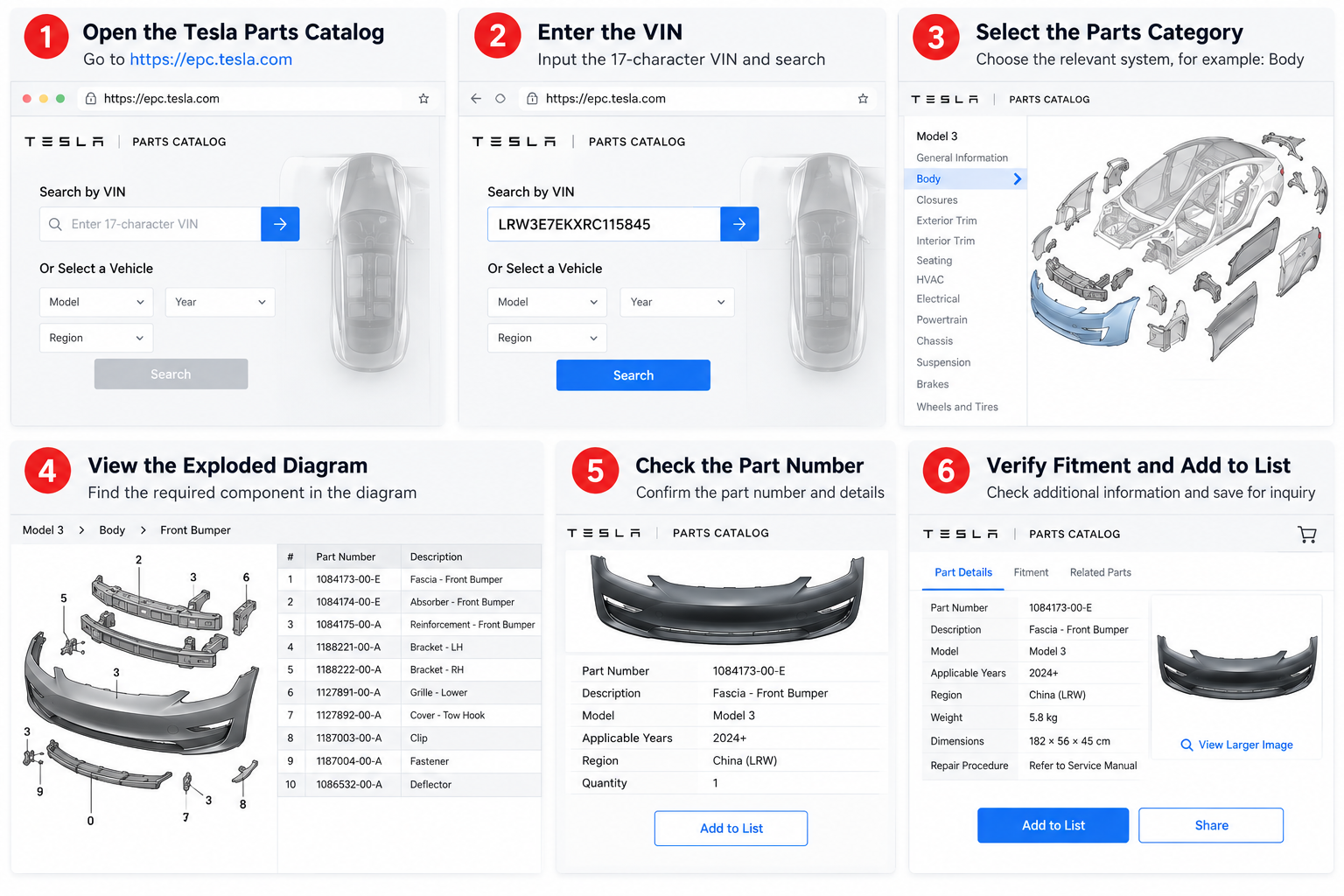
Tesla provides an official online Tesla parts catalog for genuine parts lookup. For professional sourcing, it is useful because you can move from vehicle information to parts categories, exploded diagrams, and individual part numbers.
If you are checking a part for one specific vehicle, start with the VIN whenever possible. A VIN gives you a much better starting point than a request such as “2023 Model Y front bumper.”
Method 1: Search by VIN
A VIN is the 17-character Vehicle Identification Number assigned to one vehicle. When the VIN is available, use it as the first step in the Tesla parts catalog. This helps narrow the search to the correct vehicle before you open the EPC diagram.
Method 2: Search by Model, Region, and Model Year
If you do not have the VIN, you can still use the Tesla parts catalog to research parts by model, region, and model year. This is useful when you are building a product list or studying a category. For an actual order, however, model and year alone may not be enough.
Why Model and Year Are Not Enough
This is one of the first lessons for anyone entering the Tesla aftermarket. Two cars can both be called Model 3 or Model Y and still require different parts.
Depending on the component, fitment can be affected by production period, vehicle generation, production factory, sales market, left-hand or right-hand drive, battery or drive configuration, VIN, and the exact OE number.
That is why a professional Tesla parts catalog should do more than show product photos. For repair shops and distributors, the useful information is the part number, vehicle application, and the details needed to confirm compatibility.
How to Read a Tesla VIN Before Using the Tesla Parts Catalog
You do not need to become a VIN expert. But if you quote, source, or sell Tesla parts regularly, you should understand the VIN information that can affect parts identification.
Here is a real VIN example:
This is a complete 17-character VIN. Instead of starting with VIN theory, we can break down the information that is useful for parts sourcing.
LRW: Shanghai Production
The first three characters are the WMI, or World Manufacturer Identifier. In this example, LRW identifies a Tesla produced in Shanghai, China.
For parts sourcing, production origin is useful because vehicles built in different factories or for different markets may require further fitment checks before a part is confirmed in the Tesla parts catalog.
Other commonly seen Tesla VIN prefixes include 5YJ for U.S.-built vehicles and XP7 for Berlin-built vehicles.
4th Character: 3 = Tesla Model 3
The fourth character in this VIN is 3, identifying the vehicle as a Tesla Model 3.
At this point, we already know that we are looking at a Shanghai-built Tesla Model 3.
5th Character: E = Four-Door, Left-Hand-Drive Configuration
The fifth character is E. In the VIN reference used in our parts-identification process, this code is associated with a four-door, left-hand-drive Model 3 configuration.
This can matter when certain components differ between left-hand-drive and right-hand-drive vehicles.
6th Character: 7 = Restraint System Code
The sixth character is 7, a restraint-system identifier related to the vehicle’s safety restraint configuration, including airbags and seat-belt systems.
7th Character: E = Battery Configuration
The seventh character is E. In our current identification reference, this code is associated with a ternary lithium battery configuration.
Battery information can become relevant when checking certain electrical, drivetrain or chassis-related parts.
8th Character: K = Dual-Motor AWD Configuration
The eighth character is K, which our reference associates with a dual-motor all-wheel-drive configuration.
This gives you another useful piece of vehicle information before moving deeper into the Tesla parts catalog.
9th Character: X = Check Digit
The ninth character is X, the VIN check digit. For everyday parts sourcing, you normally do not need to calculate this manually.
10th Character: R = 2024 Model Year
The tenth character is R, identifying this as a 2024 model year vehicle.
The model year is useful for parts identification, but it does not mean that every 2024 Model 3 automatically uses the same component. Exact fitment still needs to be checked.
11th Character: C = Shanghai Factory
The eleventh character is C, which points to Shanghai production in the VIN reference we use. This supports the production information already indicated by the LRW prefix.
12th–17th Characters: 115845 = Production Sequence
The final six characters, 115845, are the vehicle’s production serial sequence.
What Can We Learn From This VIN?
| Vehicle Information | Identification |
|---|---|
| VIN | LRW3E7EKXRC115845 |
| Model | Tesla Model 3 |
| Manufacturing Origin | Shanghai, China |
| Driving Configuration | Left-hand drive |
| Battery | Ternary lithium configuration |
| Drive Configuration | Dual-motor AWD |
| Model Year | 2024 |
| Production Factory | Shanghai |
| Production Sequence | 115845 |
We now have a much clearer vehicle profile. But we still do not know which exact bumper, headlamp, mirror, control arm, or other component the vehicle needs.
VIN identifies the vehicle. The Tesla parts catalog identifies the part.
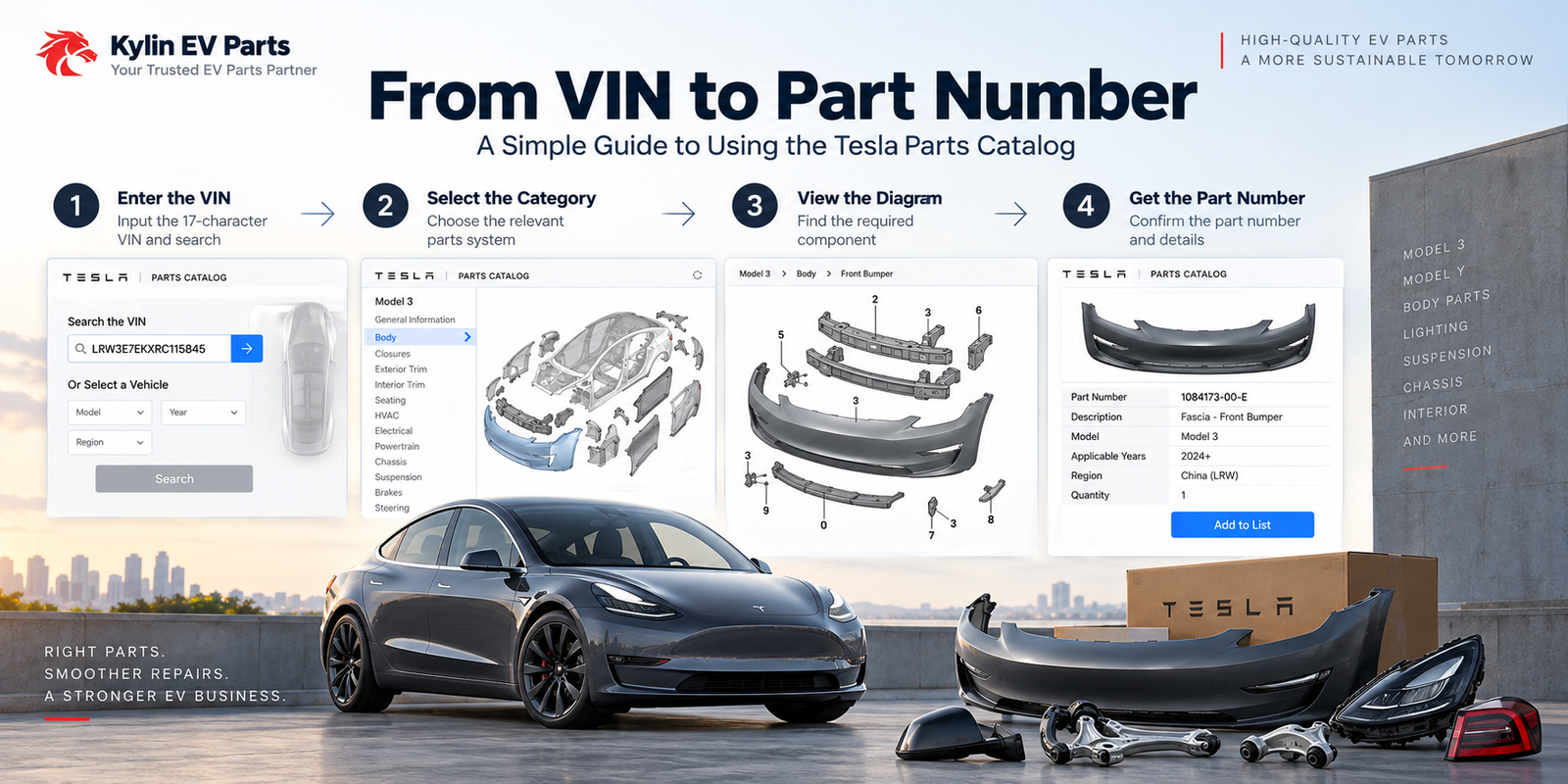
Once the vehicle information is clear, you can use the VIN in the Tesla parts catalog, open the relevant EPC diagram, locate the required component, and confirm the corresponding Tesla part number.
How to Find a Tesla Part Number in the Tesla Parts Catalog
Once the vehicle has been identified, the Tesla parts catalog becomes much easier to use. A practical parts lookup normally follows six steps.
- Get the VIN.
Ask the customer or repair shop for the complete 17-character VIN whenever possible. - Open the Tesla parts catalog.
For one specific vehicle, start with VIN-based identification. - Select the correct parts category.
Go to the relevant group, such as body, lighting, suspension, chassis, or interior. - Open the EPC exploded diagram.
Use the drawing to identify the location of the required component. - Record the Tesla part number.
A part number is much more useful for professional sourcing than a vague description such as “Model 3 control arm.” - Confirm fitment before ordering.
If anything is unclear, send the VIN, part number, and a clear product photo to the supplier.
This workflow is especially useful when a customer does not know the correct English part name or sends only a photo of the damaged area.
The Tesla parts catalog gives you a structured way to move from vehicle information to the correct exploded drawing and then to the correct part number.
What to Send When Requesting Tesla Parts
A good inquiry saves time for both the buyer and the supplier. Whenever possible, send:
- VIN
- Tesla model
- Model year
- OE or part number
- Part name
- Photo of the original or damaged part
- Quantity
- Preferred quality or sourcing option
If the OE number is unknown, a VIN plus a clear photo is often enough to start the identification process. The supplier can then use the Tesla parts catalog and other parts-matching resources to confirm the component.
Tesla Parts Catalog for Repair Shops, Wholesalers and Distributors
The official Tesla parts catalog is excellent when you need to identify one component. But finding a part and building a parts business are two different jobs.
If you are a traditional auto parts distributor entering the Tesla market, searching the EPC one part at a time will tell you what exists.
It will not tell you which products sell fastest, how many SKUs you should start with, which categories deserve inventory, or where aftermarket alternatives make sense.
For day-to-day B2B work, an Excel-based Tesla parts catalog with part numbers can be more practical for quotation, sourcing, and stock planning.
A useful working catalog should include:
| Information | Why It Matters |
|---|---|
| OE Number | Accurate parts identification |
| Part Name | Product recognition and quotation |
| Tesla Model | Vehicle coverage |
| Production Period | Fitment reference |
| Parts Category | Inventory management |
| Quality or Source Option | Purchasing decision |
| Product Photo | Faster identification |
The goal is not to replace the official Tesla parts catalog. The goal is to turn parts information into a format that your purchasing and sales team can actually use.
Which Tesla Parts Should a New Distributor Stock First?
This is where the Tesla parts catalog reaches its limit.
A parts catalog tells you what exists. Sales data tells you what to stock.
A new distributor does not need every Tesla SKU on day one. Buying too many slow-moving parts can lock working capital into inventory before the business has had time to prove itself.
A more practical approach is to study high-demand categories first, including:
- Suspension and chassis parts
- Collision and body parts
- Lighting parts
- Mirrors
- Common replacement and wear parts
- Fast-moving Model 3 and Model Y parts
The right first inventory depends on your local Tesla population, customer base, repair market, and budget. A body shop supplier may need a very different mix from a mechanical repair parts wholesaler.
That is why you shouldn’t just download a Tesla parts catalog and buy random products from it. Start with a SKU strategy built around turnover.
How to Start a Tesla Parts Business
If you already sell traditional auto parts, you do not need to rebuild your whole company around Tesla. You can test the market step by step.
Learn the Tesla EPC → understand VIN and OE identification → choose your target models → identify fast-moving SKUs → build a trial inventory → collect local sales data → expand the categories that actually move.
Your goal is not to own the biggest Tesla parts catalog.
Your goal is to turn inventory into sales.
Need a Complete Tesla Parts Catalog in Excel?
If you are a repair shop, auto parts wholesaler, importer, or distributor and need a complete Tesla parts catalog in Excel format, contact Kylin EV Parts to request a copy.
Compared with searching an online EPC one part at a time, an Excel Tesla parts catalog is more practical for quotation, parts matching, purchasing, and inventory planning.
About Kylin EV Parts
Kylin EV Parts is a China-based B2B supplier specializing in EV replacement parts. For Tesla, we focus on aftermarket and used parts for Model 3, Model Y, and other Tesla models.
Our product range includes body, lighting, suspension, chassis, interior, and other repair and replacement parts. Our Tesla supply system covers more than 2,000 SKUs.
We do not want to send buyers just another Tesla parts catalog. We help professional customers identify the correct parts and build a sourcing structure that works for their business.
Planning to Start a Tesla Parts Business?
If you already sell traditional automotive parts and want to enter the Tesla aftermarket, you do not need to select your first inventory from thousands of SKUs by yourself.
Kylin EV Parts has prepared two starter packages built around fast-moving Tesla parts.
$10,000 Tesla Parts Business Starter Package
Designed for companies that want to test the market with a smaller initial investment and a focused mix of higher-turnover SKUs.
$20,000 Tesla Parts Business Starter Package
Designed for distributors that want broader initial product coverage and a more complete Tesla inventory structure.
These packages are not random products selected from a Tesla parts catalog. The aim is to put more of your first investment into parts with stronger turnover potential.